The more independent our free will becomes with age ,
the more barriers we impose on ourselves with our self made boundries......
Early morning temple visit
Awakened the spirit within me
All problems now seemed so small
I could win them one and all
All negative thoughts went aside
And peace originated from my inside.
And as a holy me walked home,
That cow calf grabbed my attention
Stuck in the drainage nearby
It meeked for help and resurrection
Temple brought out my passion and zeal
A God’s soldier is born to heal
Half hour of diligent hard toil
I rescued the calf back on firm soil
It started caressing my feet in affection
It seemed reward enough for my good intentions
But just then from afar,
The calf owner came up running,
Short of breath but not short of thanks
It carried away its calf while brimming
Looking at the owner and calf depart,
Satisfaction took leave from my heart
All my efforts seemed a waste.
Not even blessings I deserve to taste
From the bounty of my Almighty grace
If only I had already known it,
While I was busy toiling to save it,
But chances of prior notion were slim,
And the cow never told me it was Muslim.
Showing posts with label Philosophy. Show all posts
Tuesday, October 26, 2010
Wednesday, October 13, 2010
Oh My God !
Born without religion
But soon enough
I am taught about my God
And taught why my God
is better than the best.
I accept it and move ahead
But time puts questions in head
It struggles to identify
Why it the best
And struggle to see what difference
It provides me from the rest.
But a difference religion provides yes
Of whether in my death
I am buried or burnt.
But then
A dead me would hardly care
Of the fire or the coffin
Or the soil affair.
So why not
Suspend religion until
I reach in my grave
And not let my life
Be its slave.
Or perhaps
Follow the religion
Which keeps me forever alive
And does not desert me
Eventually to death side
But such a religion
Alas
Can never be
For,God I was taught
But immortality
How can they teach me ?.
But soon enough
I am taught about my God
And taught why my God
is better than the best.
I accept it and move ahead
But time puts questions in head
It struggles to identify
Why it the best
And struggle to see what difference
It provides me from the rest.
But a difference religion provides yes
Of whether in my death
I am buried or burnt.
But then
A dead me would hardly care
Of the fire or the coffin
Or the soil affair.
So why not
Suspend religion until
I reach in my grave
And not let my life
Be its slave.
Or perhaps
Follow the religion
Which keeps me forever alive
And does not desert me
Eventually to death side
But such a religion
Alas
Can never be
For,God I was taught
But immortality
How can they teach me ?.
Wednesday, September 8, 2010
The symbol of life
While surfing through the Internet, I came across Ankh – the symbol of life. This symbol was first conceptualized by Egyptian culture. Further exploration of the topic made me realize that symbol Ankh depicts the origination of life – It is a symbol for the initiation of life.
The interesting topic made me wonder – “What could be the symbol of our whole life?”
Many symbols came to mind but none of them seemed to fit the subject perfectly. Then suddenly a symbol popped in my mind which I had seen in a book of Fritjof Capra – The Turning Point.
The symbol is -
In the beginning there is nothing, then life originates. With the passage of time we begin to accumulate and build knowledge, wisdom, strength, independence, and a personality. We do new and different things. Initially this happens at a slow pace, then we get an acceleration a s denoted by the symbol.
Then with the passage of more time we begin to reach the top part – the plateau. We begin to slow down. Our spirit, mind and body no longer yearn for adventure but for stability. We start getting into a routine. We tend to become less flexible and inquisitive.
Then slowly it starts to decrease – the downward trend begins .We no longer have the energy of the past, our minds cannot accept concepts which we do not already know. Finally the day comes when it is all over.
The symbol might seem to be showing a disappointing pattern of leading life. But it is actually the natural pattern - we cannot avoid this pattern. Part of this pattern may be forced by us on ourselves due to the hindrances of our mind but part of it also forced on us by our body.
What perhaps we can try is to skew the pattern as much as we can and extract the most out of our life.
This skewed pattern shows us that we continue to livewith a young body, mind and soul until a very late stage .
This can be achieved if we keep ourselves
physically and mentally fit.
This skewed pattern also prevents the fall
by keeping a healthy body mind and soul,
Perhaps the best possible way to achieve something like the above two patters could to follow a lifestyle depicted by this graph –
trying new things , different things, periodic vacations ,periodic activities which break the routine etc etc from time to time.
PS -- If you have any other symbol which you think would stand for life , do share the same.
Wednesday, September 1, 2010
The eighth color of the rainbow
Have you ever wondered what is colour?
As per physics colour is that band of light spectrum (the range of wavelengths) which the human eye can detect. This band of spectrum is passed to the human brain which in turn , helps us to perceive color.
The human eye has three types of cones or colour receptors – Red, Green and Blue(Red , Blue and green are the three primary colours for us). These three types of cones can absorb wavelengths from 420 – 700 nanometres and help us detect about 100 different gradations of colours. The human brain combines these 100 gradations to enable the average human to distinguish about 1 million different colors
But what if our eye can be engineered to detect a wider range of spectrum? Imagine if our eye can have another type of cone to detect more primary colors? This special quality already exists in many animals and some humans, Read - Tetrachromat
Imagine how our new world would be like if we became a tetrachormat or pentachormat or something even beyond?
The rainbow would no longer be of seven colours. The world would be full of new colors and shades. How and with what words would you describe such a world? How would you describe and explain a colour you never saw before. Everything – living or object would look and feel different.
Imagine the impact on culture, art and literature. They would be redefined. All the famous painting of the world would now be fresh. Literature would be at a loss of words. The poetic expressions - purple rain, green mile; red rose might turn out to be incorrect. The crow might no longer be black. The grass might not be green now on any of the sides. Pink might no longer be the favourite colour of all the girls.
Imagine the impact technology and fashion. The best resolution monitors would suddenly feel pale. There would now be more shades to permute on the dresses – these new colors would rule the ramp and our minds.
Imagine the impact on our physic. We might initially find it difficult to even identify old and familiar things. We may develop new feelings. We would literally see our old world falling down in front of our eyes and new world takings its place. It would force us to revise the fundamental concept set in our brain. It will make us realize that our perception of things is just a model. There is no absolute truth –
"The sky is no longer blue; it just used to be;
The sky was never blue, we just used to see."
Perhaps we need such a magical experience to crumble down the rigid walls which have trapped our free will. Perhaps we need such an experience to revitalize, the once considered most important trait of humans – ‘To question something and not believe in it blindly’.
Perhaps we need the eighth colour of the rainbow to appreciate the existing seven.
As per physics colour is that band of light spectrum (the range of wavelengths) which the human eye can detect. This band of spectrum is passed to the human brain which in turn , helps us to perceive color.
The human eye has three types of cones or colour receptors – Red, Green and Blue(Red , Blue and green are the three primary colours for us). These three types of cones can absorb wavelengths from 420 – 700 nanometres and help us detect about 100 different gradations of colours. The human brain combines these 100 gradations to enable the average human to distinguish about 1 million different colors
But what if our eye can be engineered to detect a wider range of spectrum? Imagine if our eye can have another type of cone to detect more primary colors? This special quality already exists in many animals and some humans, Read - Tetrachromat
Imagine how our new world would be like if we became a tetrachormat or pentachormat or something even beyond?
The rainbow would no longer be of seven colours. The world would be full of new colors and shades. How and with what words would you describe such a world? How would you describe and explain a colour you never saw before. Everything – living or object would look and feel different.
Imagine the impact on culture, art and literature. They would be redefined. All the famous painting of the world would now be fresh. Literature would be at a loss of words. The poetic expressions - purple rain, green mile; red rose might turn out to be incorrect. The crow might no longer be black. The grass might not be green now on any of the sides. Pink might no longer be the favourite colour of all the girls.
Imagine the impact technology and fashion. The best resolution monitors would suddenly feel pale. There would now be more shades to permute on the dresses – these new colors would rule the ramp and our minds.
Imagine the impact on our physic. We might initially find it difficult to even identify old and familiar things. We may develop new feelings. We would literally see our old world falling down in front of our eyes and new world takings its place. It would force us to revise the fundamental concept set in our brain. It will make us realize that our perception of things is just a model. There is no absolute truth –
"The sky is no longer blue; it just used to be;
The sky was never blue, we just used to see."
Perhaps we need such a magical experience to crumble down the rigid walls which have trapped our free will. Perhaps we need such an experience to revitalize, the once considered most important trait of humans – ‘To question something and not believe in it blindly’.
Perhaps we need the eighth colour of the rainbow to appreciate the existing seven.
Saturday, July 24, 2010
What if God was one of us....
What if God was one of us,
Just a slob like one of us.
Just a stranger on the bus,
What if God was one of us ?
Just a slob like one of us.
Just a stranger on the bus,
What if God was one of us ?
Lyrics of Song from Joan Osbome . Watch the song on You Tube here
As uncanny and as thought provoking the song may be, imagine another thought provoking scenario- Among all of us on this earth, YOU are given the privilege to be GOD?
Lucky You!! Or so it seems at the first instant. For however excitig the opportunity sounds, it comes with its set of unique dilemmas. For starters, there are so many Gods in this world, .so which God to be? Without a doubt you deserve the best (after all , you are God). So why be any other God and why not be the best God?
As uncanny and as thought provoking the song may be, imagine another thought provoking scenario- Among all of us on this earth, YOU are given the privilege to be GOD?
Lucky You!! Or so it seems at the first instant. For however excitig the opportunity sounds, it comes with its set of unique dilemmas. For starters, there are so many Gods in this world, .so which God to be? Without a doubt you deserve the best (after all , you are God). So why be any other God and why not be the best God?
So the dilemma now reshapes itself into - To find which God is the best? Your dilemma is made even more difficult when you realize that you cannot approach anyone for advice. After all, every person would claim that the God he/she follows is the best God.
After realizing that your Social Network will not be able to help you out on this one, you decide to try your hands at History only to discover that human history is tainted with the loss of countless lives in an attempt to put one God better than the other. But amidst all this bloodshed, History still fails to point toward a Supreme God among other Gods.
Keeping History books into history, you decide to research a modern text. Maybe modern analysis can solve your dilemma .You get hold of the book, If world were a Village. The book tells you that if on this earth there were only 100 people -- 33 would be Christians, 18 Muslims, 14 Hindus, 16 Non Religious, 6 Buddhists and 13 followers of other religions..
Aha! This gives some pointers. Should you become the God which most people follow? But does this line of thought not imply that the lesser followed Gods are the lesser Gods? Doubtful of this hypothesis, you lunge into the field of Sales expecting to see some light. But alas, as you feared, Sales teaches you that there is no definite relationship pattern between the numbers of consumers of a product and the quality of that product. There are many other parameters which collectively affect the end users choice. So you realize that the parameter ‘Number of followers of a God ‘ is not a sufficient one to choose The God among Gods. (I told you at the start, it won’t be an easy problem solve)
Perplexed by your dilemma, you come up with an exhaustive solution - Study about each God that there is and then decide which God is the Numero Uno!. As comprehensive as the idea sounds ,let me warn you it is not a practical one. Just to give you the reason behind my apprehension , when you would reach Buddhism in your study, you will find the Buddha has 32 avatars. So you have to 32 avatars to understand the Buddha. Oh! What do you say – 32 is not such a big number. You can study the 32 avatars. Okay, But then let me tell you about Hinduism, The total Gods in Hinduism is 330000. By the time you would complete the study of their life, your life would be completed.. Case closed!You seem to be a bit lost now with all these approaches failing to give you an answer. Let me suggest you a compromise – Instead of choosing the best God , let us only decide to choose the best religion. It seems a more manageable prospect. It is also very closely related to the initial dilemma - after all , it was God only who gave religion to men and women ( Or was it the other way round ? Let’s not dwell into it , we have work to do ).
And on top of other things, your decision would also help the whole human race. The whole race has been fighting among themselves for ages to prove their religion as supreme, Maybe you can decide for them and settle the issue once and for all, And they are sure to agree with your decision ( after all you are God 1 )
So let us work together and try to list down the major teachings of the various religions of the world. Then we will try to categorize the teaching into some categories so that we can analyse them in detail. So let’s get to work .............................
And there!!, we have the table ready below. Now all we need to do is analyse and pick out the best religion
.
Yes, my friend, I am as shocked as you are -- All the religions teach the exact same things via their respective Gods and via their own respective means ??!!
But why then have humans been fighting among themselves since time immemorial to prove that their religion and their God is better than the religion and God of others? Apologies my friend, I have no idea how to answer this new dilemma. But I have a feeling that the day every human starts taking the trouble to ponder over this question, the world would be a better place. Do you share the same feeling my friend?
What if god was one of us
Just a slob like one of us
Just a stranger on the bus
Just trying to make his way home
Like a holy rolling stone
Back up to heaven all alone
Just trying to make his way home
Nobody calling on the phone
Except for the Pope maybe in Rome...
But why then have humans been fighting among themselves since time immemorial to prove that their religion and their God is better than the religion and God of others? Apologies my friend, I have no idea how to answer this new dilemma. But I have a feeling that the day every human starts taking the trouble to ponder over this question, the world would be a better place. Do you share the same feeling my friend?
What if god was one of us
Just a slob like one of us
Just a stranger on the bus
Just trying to make his way home
Like a holy rolling stone
Back up to heaven all alone
Just trying to make his way home
Nobody calling on the phone
Except for the Pope maybe in Rome...
Sunday, July 11, 2010
The Two of Me
There are moments in our life where we stare at defeat and difficult times.
We are at the crossroads - we do not know what to do.
At these times, our inner self seems divided in two - our I and You.
We stop , listen to both and we think..........
Then
Some of us follow the I
and
Some of us follow the You.
The Me – I
A fear hides in the heart
That dreams would die only as dreams
Unfulfilled ambitions yet
And soul would depart
Body would lay satisfied
But wanting soul would still scream.
A fear hides in the heart
That dreams would die only as dreams
Unfulfilled ambitions yet
And soul would depart
Body would lay satisfied
But wanting soul would still scream.
Even then ,
No more dreams now I strive to pure
No new dimensions I try to explore
Too many constrains the free will found
It killed the dreams, I lived to bound
Too many constrains the free will found
It killed the dreams, I lived to bound
So I live now this vegetative life
Daily chores and no delight
No excitement in life for sure
But at least pain I bear No More !
The Me - You
You may fear to die,
You may not - I cannot say
But you fear to live
One by one you kill each day
Intense pain is better
Slow pain to death – Never!
Dormant life is sin for sure
So precious life is
Vegetation is no cure .
Daily chores and no delight
No excitement in life for sure
But at least pain I bear No More !
The Me - You
You may fear to die,
You may not - I cannot say
But you fear to live
One by one you kill each day
Intense pain is better
Slow pain to death – Never!
Dormant life is sin for sure
So precious life is
Vegetation is no cure .
Attempt and action
Coulld bring joy
Could bring sorrow
But they bring an alive tomorrow
Dream and decision
But they bring an alive tomorrow
Dream and decision
May give pain
May give gain
But they make you live again.
Inaction is state of defeated mind.
A champion lives each moment
All the time.
Today you vegetate
By taming your soul
Tomorrow the body
With age will tame you old
Before you decay
Yourself you cure
One life, Do More !
By taming your soul
Tomorrow the body
With age will tame you old
Before you decay
Yourself you cure
One life, Do More !
Thursday, July 1, 2010
The Full Cycle
Mari - Have you ever ridden a cycle in your life?
Sam - Yes
Mari - Do you still ride a cycle?
Sam - No
If we reflect upon our life and try to recollect the most cherished moments that we have experienced so far in our journey, we would discover that the majority of these moments were part of our childhood phase. Those indeed were the good old days! And if we dig a bit more into the cherished moments of our childhood, we would, without doubt find that a few of these incidents have a bicycle embedded in it.
The cycle and its cousins have a very special relationship with us. They touch and shape every stage of our life.
We might not realize, but the cycle; in its various forms influences us in so many ways-------
When we are born, a distance relative of the cycle – The Cradle surrounds us with its protection. The Cradle helps us to journey around the world even before our legs take up that responsibility.
With the passage of time, we grow out of the cradle and climb on the Tricycle. It is our first independent vehicle. It is we who control where to take it and with what speed to drive it. It is a friend which helps us explore the world, a friend which rides with us through impossible curvy and crooked places, a friend which takes many a falls with us but a friend which always is ready to go wherever our infant imagination wants to take us.
As we grow up a bit more, the tricycle becomes a thing of the past and out comes the Bicycle. The Bicycle is a big step in our life. When we dash on our bicycle, it gives us a taste of the speed, which is required by us to move ahead in life. When we fall down from our bicycle, it gives us a taste of the pains that life has to offer. When we complete our first bicycle ride without anyone’s support, it gives us a taste of thrill, freedom and confidence required to live.
Then as we grow up even more, we abandon the cycle and its relatives for the more comfortable means of commutation. The Cycle, from being a tool of discovery ends up being just a piece of decoration. And with time, the piece of decoration decays into a piece of debris for us.
We abandon the Cycle and throw it out of our house and out of our life. But the cycle, which was our best friend, is not able to come to terms with the fact that we have given up on the friendship. It desperately tries to come back to us, albeit in the form of a exercise equipment in the gym but there also it hardly gets any extended attention from us.
With time the Cycle realizes that it is not wanted anymore. It then waits patiently and watches us live our life. It watches and sees that the day has come when life has caught up with us, it sees the day has come when our limbs have began begin to fail us.
At this lonely stage of our life, when not many people want to talk to us, we can but only sit down and reflect on our past days and realize that one friend is still waiting for us in the junkyard outside the house – Our old Bicycle.
But alas, when we could, we deserted it .Now, even though we want to, we cannot cycle anymore. Our body no longer has the strength to do so .We can only think about the time when we cycled and take pleasure in the vicarious thrills.
Our eternal buddy, the Cycle realizes our state. It stays aloof, as it is angry with us for we deserted it for years together. But eventually , for the sake of friendship it decides to come back to us and free us of our loneliness and helplessness --- The Wheel Chair helps us to journey around the world even after our legs have given up that responsibility.
Mari - Have you ever ridden a cycle in your life?
Sam - Yes
Mari - Do you still ride a cycle?
Sam – No
Mari – Would you ride it in the future?
Sam - I ………………
Sam - Yes
Mari - Do you still ride a cycle?
Sam - No
If we reflect upon our life and try to recollect the most cherished moments that we have experienced so far in our journey, we would discover that the majority of these moments were part of our childhood phase. Those indeed were the good old days! And if we dig a bit more into the cherished moments of our childhood, we would, without doubt find that a few of these incidents have a bicycle embedded in it.
The cycle and its cousins have a very special relationship with us. They touch and shape every stage of our life.
We might not realize, but the cycle; in its various forms influences us in so many ways-------
When we are born, a distance relative of the cycle – The Cradle surrounds us with its protection. The Cradle helps us to journey around the world even before our legs take up that responsibility.
With the passage of time, we grow out of the cradle and climb on the Tricycle. It is our first independent vehicle. It is we who control where to take it and with what speed to drive it. It is a friend which helps us explore the world, a friend which rides with us through impossible curvy and crooked places, a friend which takes many a falls with us but a friend which always is ready to go wherever our infant imagination wants to take us.
As we grow up a bit more, the tricycle becomes a thing of the past and out comes the Bicycle. The Bicycle is a big step in our life. When we dash on our bicycle, it gives us a taste of the speed, which is required by us to move ahead in life. When we fall down from our bicycle, it gives us a taste of the pains that life has to offer. When we complete our first bicycle ride without anyone’s support, it gives us a taste of thrill, freedom and confidence required to live.
Then as we grow up even more, we abandon the cycle and its relatives for the more comfortable means of commutation. The Cycle, from being a tool of discovery ends up being just a piece of decoration. And with time, the piece of decoration decays into a piece of debris for us.
We abandon the Cycle and throw it out of our house and out of our life. But the cycle, which was our best friend, is not able to come to terms with the fact that we have given up on the friendship. It desperately tries to come back to us, albeit in the form of a exercise equipment in the gym but there also it hardly gets any extended attention from us.
With time the Cycle realizes that it is not wanted anymore. It then waits patiently and watches us live our life. It watches and sees that the day has come when life has caught up with us, it sees the day has come when our limbs have began begin to fail us.
At this lonely stage of our life, when not many people want to talk to us, we can but only sit down and reflect on our past days and realize that one friend is still waiting for us in the junkyard outside the house – Our old Bicycle.
But alas, when we could, we deserted it .Now, even though we want to, we cannot cycle anymore. Our body no longer has the strength to do so .We can only think about the time when we cycled and take pleasure in the vicarious thrills.
Our eternal buddy, the Cycle realizes our state. It stays aloof, as it is angry with us for we deserted it for years together. But eventually , for the sake of friendship it decides to come back to us and free us of our loneliness and helplessness --- The Wheel Chair helps us to journey around the world even after our legs have given up that responsibility.
Mari - Have you ever ridden a cycle in your life?
Sam - Yes
Mari - Do you still ride a cycle?
Sam – No
Mari – Would you ride it in the future?
Sam - I ………………
Sunday, June 20, 2010
Transactional Analysis
All of us have a unique pattern of thinking and a unique pattern of responding to the various situations we are confronted with. The response of every individual to an exactly identical situation is unique. The collection of all these unique responses of an individual helps us identify a particular personality with the individual.
But, why do we think and act in a particular manner, favouring a particular response or a approach more than the other?
We can answer the above question if we can identify the parameters which define our responses. The knowledge of these responses can help us modify, restructure and fine-tune these parameters to make our personalities more flexible and more adaptable to situations.
Transactional Analysis (TA) - An analysis technique in physiology developed by Eric Berne can help us to answer the above asked question.
The basis of Transactional Analysis is the assumption that our brains stores and records each and every experience which we encounter in our lifetime. This total collection of experiences in our brain defines our personality. And when we experience our next event, the brain interprets and responds to it based on the historic data stored inside it.
The assumption stated above has been proven by medical science. Various neurological experiments, physiological examinations and other scientific analysis have proven that our brains stores and records our each and every experience. Along with that, the brain also stores each and every visual image, sound and emotional feeling experienced by us during a particular experience. Any stimulus which maps to any of these old stored data can make us relive the earlier experience.
An obvious question which comes up is; if the brain records everything, why do we forget so many things in our day to day life? It is because we can forcefully retrieve only a small set of data from our brain. This is because even though our brain is an excellent recorder, the querying aspect of our brain is underdeveloped. But it does not mean that if we cannot access any particular data, the data is lost forever. This inaccessible data can be accessed by the brain at a sub-conscious level (without us releasing it) to respond to situations.
We can understand the above retrieval concept with the help of a common incident. Recall the incident when you met an old friend of yours after a gap of few years.Statements such as “Oh! You have grown so tall? You have put on some weight!” are common in such meetings.
Now, if just before meeting your friend, someone would have asked you – “How did your friend look like when you met him/her the last time? What was the height of your friend when you met him/her the last time?” You might not recall with much accuracy the required details. But on meeting your friend, you are able to detect the slightest change in the facial characteristics, height and weight of your friend. It means the old data about your friend is precisely stored somewhere in the brain and used by the brain for comparison at a sub conscious level. This example shows us that our brain has all the data but forceful retrieval of all this data is beyond our capacity.
Once (and if) we are now comfortable with the assumption which Transactional Analysis utilizes, let us look into Transactional Analysis.
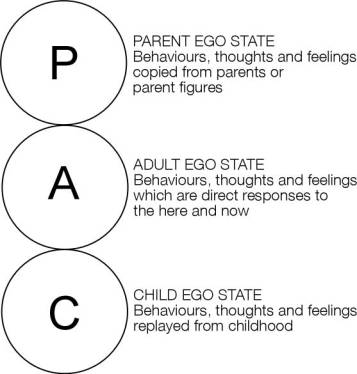
As per Transactional analysis – this capacity of the brain to record all our experiences and use them at a sub conscious level causes our personality to be segmented into 3 parts –
• The Parent
• The Child
• The Adult.
Remember these are not the stages of life but the segments of our personality. These three segmented parts work together to form our personality.
Let’s understand the characteristics of these three segments-
The Parent
The Parent is the huge collections of recordings which are stored in our brain unquestioned or as ultimate facts. Most of the Parent is formed in the first 5 years of our life. Even after that, although at a slow rate, the adult keeps growing throughout our lifetime.
e.g. - When we are young, we are taught “Always use right hand for handshakes. Using a left hand is bad “. This fact is recorded in our brains. We start to believe in it without questioning. Even today, as a grown up, we feel reluctant to prefer our left hand for important things. Don't we?
The Child
While external events are recorded in the Parent, the feelings associated with these events are stored in the Child. Most of the Child is formed in the first 5 years of our life but just like the Parent, the Child also keeps growing throughout our lifetime.
e.g. – When we are young, we all have experienced incidents where people laughed at us when we made mistakes. This could happen while making an error while reading out from a book in class or while we may have fell down while playing etc. These feelings of public embarrassment remains etched in our brains forever. That is why we fear public speaking and centre-stage so much. We face an audience and we start shaking all over.
The Adult
The adult starts developing around the age of 4, when we ;earn how to crawl and walk around, The adult keeps getting more active as we grow up. As the adult starts growing , growth rate of the Parent and the Child slows down.
The growth of Adult can be associated with the growing inquisitiveness in young ones. The Adult does not agree to store any data without its analysis and validation. The Adult is the analyzer and used the data from Parent, Child and Adult experience to build up its response. It tries to explore and find answers.
The data of the Parent and the Child is experienced by us as our inner voice, inner feeling, voice of the heart, gut feeling response to any situation. The data of the Adult help us to approach a situation via logical deduction, analysis and thought process.
All of us have different data stored in these three segments of our brain as our experiences are unique. Hence, our response, reactions, thought processes and weightage to different issues are unique.
Lets see discussion practical examples to understand how our reactions are different based on different triggers.
1. Seeing a cockroach
Many of us freak out when we see a cockroach because some of us almost programmed in our Child be scared of the cockroach. When we are young we have seen people terrorized on seeing a cockroach. The sight of the cockroach triggers the old Child memory and we experience the same terror as a natural reaction. Things would not be so scary if we gave ourselves a chance to think about the same and practise to let our Adult be triggered on seeing the Cockroach.
2. Questions on Core beliefs
We do not let anyone question our core beliefs like God, Religion, Morals etc. They are deep rooted in our Parent. We never question them or let others question them. No matter how good at negotiating (An Adult characteristics) and discussion (An Adult characteristics) we may be , we may be not at all entertain the idea of anyone questioning our core beliefs .They are de facto correct for us and there is not need for discussions on them.
3. Instinct
The Instinct is provided by the Child and the Parent. Many times our Adult logical analysis may tell us something else but we our inner belief, our gut feeling for a situations says something else. A large number of times our gut feeling is right as well .We cannot explain why the Adult response felt wrong but we knew it was wrong. It is because the Child and the Parent do not use logical deduction to come to a conclusion but that does not mean that they are wrong.
The above practical examples give us a peek into the vast scope of areas where transactional analysis could help us. For instance, It can help us to understand ourselves better, understand and interact with others efficiently with others and so on.....
If you find the topic interesting and worth exploring; I would recommend you a book –“ I'm Ok , You're Ok” by Thomas A Harris.
But, why do we think and act in a particular manner, favouring a particular response or a approach more than the other?
We can answer the above question if we can identify the parameters which define our responses. The knowledge of these responses can help us modify, restructure and fine-tune these parameters to make our personalities more flexible and more adaptable to situations.
Transactional Analysis (TA) - An analysis technique in physiology developed by Eric Berne can help us to answer the above asked question.
The basis of Transactional Analysis is the assumption that our brains stores and records each and every experience which we encounter in our lifetime. This total collection of experiences in our brain defines our personality. And when we experience our next event, the brain interprets and responds to it based on the historic data stored inside it.
The assumption stated above has been proven by medical science. Various neurological experiments, physiological examinations and other scientific analysis have proven that our brains stores and records our each and every experience. Along with that, the brain also stores each and every visual image, sound and emotional feeling experienced by us during a particular experience. Any stimulus which maps to any of these old stored data can make us relive the earlier experience.
An obvious question which comes up is; if the brain records everything, why do we forget so many things in our day to day life? It is because we can forcefully retrieve only a small set of data from our brain. This is because even though our brain is an excellent recorder, the querying aspect of our brain is underdeveloped. But it does not mean that if we cannot access any particular data, the data is lost forever. This inaccessible data can be accessed by the brain at a sub-conscious level (without us releasing it) to respond to situations.
We can understand the above retrieval concept with the help of a common incident. Recall the incident when you met an old friend of yours after a gap of few years.Statements such as “Oh! You have grown so tall? You have put on some weight!” are common in such meetings.
Now, if just before meeting your friend, someone would have asked you – “How did your friend look like when you met him/her the last time? What was the height of your friend when you met him/her the last time?” You might not recall with much accuracy the required details. But on meeting your friend, you are able to detect the slightest change in the facial characteristics, height and weight of your friend. It means the old data about your friend is precisely stored somewhere in the brain and used by the brain for comparison at a sub conscious level. This example shows us that our brain has all the data but forceful retrieval of all this data is beyond our capacity.
Once (and if) we are now comfortable with the assumption which Transactional Analysis utilizes, let us look into Transactional Analysis.
As per Transactional analysis – this capacity of the brain to record all our experiences and use them at a sub conscious level causes our personality to be segmented into 3 parts –
• The Parent
• The Child
• The Adult.
Remember these are not the stages of life but the segments of our personality. These three segmented parts work together to form our personality.
Let’s understand the characteristics of these three segments-
The Parent
The Parent is the huge collections of recordings which are stored in our brain unquestioned or as ultimate facts. Most of the Parent is formed in the first 5 years of our life. Even after that, although at a slow rate, the adult keeps growing throughout our lifetime.
e.g. - When we are young, we are taught “Always use right hand for handshakes. Using a left hand is bad “. This fact is recorded in our brains. We start to believe in it without questioning. Even today, as a grown up, we feel reluctant to prefer our left hand for important things. Don't we?
The Child
While external events are recorded in the Parent, the feelings associated with these events are stored in the Child. Most of the Child is formed in the first 5 years of our life but just like the Parent, the Child also keeps growing throughout our lifetime.
e.g. – When we are young, we all have experienced incidents where people laughed at us when we made mistakes. This could happen while making an error while reading out from a book in class or while we may have fell down while playing etc. These feelings of public embarrassment remains etched in our brains forever. That is why we fear public speaking and centre-stage so much. We face an audience and we start shaking all over.
The Adult
The adult starts developing around the age of 4, when we ;earn how to crawl and walk around, The adult keeps getting more active as we grow up. As the adult starts growing , growth rate of the Parent and the Child slows down.
The growth of Adult can be associated with the growing inquisitiveness in young ones. The Adult does not agree to store any data without its analysis and validation. The Adult is the analyzer and used the data from Parent, Child and Adult experience to build up its response. It tries to explore and find answers.
The data of the Parent and the Child is experienced by us as our inner voice, inner feeling, voice of the heart, gut feeling response to any situation. The data of the Adult help us to approach a situation via logical deduction, analysis and thought process.
All of us have different data stored in these three segments of our brain as our experiences are unique. Hence, our response, reactions, thought processes and weightage to different issues are unique.
Lets see discussion practical examples to understand how our reactions are different based on different triggers.
1. Seeing a cockroach
Many of us freak out when we see a cockroach because some of us almost programmed in our Child be scared of the cockroach. When we are young we have seen people terrorized on seeing a cockroach. The sight of the cockroach triggers the old Child memory and we experience the same terror as a natural reaction. Things would not be so scary if we gave ourselves a chance to think about the same and practise to let our Adult be triggered on seeing the Cockroach.
2. Questions on Core beliefs
We do not let anyone question our core beliefs like God, Religion, Morals etc. They are deep rooted in our Parent. We never question them or let others question them. No matter how good at negotiating (An Adult characteristics) and discussion (An Adult characteristics) we may be , we may be not at all entertain the idea of anyone questioning our core beliefs .They are de facto correct for us and there is not need for discussions on them.
3. Instinct
The Instinct is provided by the Child and the Parent. Many times our Adult logical analysis may tell us something else but we our inner belief, our gut feeling for a situations says something else. A large number of times our gut feeling is right as well .We cannot explain why the Adult response felt wrong but we knew it was wrong. It is because the Child and the Parent do not use logical deduction to come to a conclusion but that does not mean that they are wrong.
The above practical examples give us a peek into the vast scope of areas where transactional analysis could help us. For instance, It can help us to understand ourselves better, understand and interact with others efficiently with others and so on.....
If you find the topic interesting and worth exploring; I would recommend you a book –“ I'm Ok , You're Ok” by Thomas A Harris.
Wednesday, June 17, 2009
Three Walls - A Poem
I was watching the movie - Theen Dewareein (Three Walls).In the movie Nasruddin Shah(one of the best actors in Indian Movie Industry) plays a convict.He is to be hanged but he plays a very enigmatic charecter - full of charm and poise , even as imminent death approaches him. He recites a couplet of 4 lines .I was really impressed by the depth of the lines and thought over it.
In the end , I extended it to a poem.
Do share your point of view on the poem.
Three Walls
Three walls are the barrier
The fourth my will
Break it I must
For then shall I be free
But free I am
For my mind is my own
Free I am to think and explore
Free I am from duties and deeds
Free enought to think beyond caste and creed
Free I am from material world and its jitters
Free I am to count by my window,the stars that glitters
Free I am to explore the powers of God
Free I am to feel nature and its rules so broad
Free I am full of leisure and peace
Free away from the urge of money all seek
Free I am for my days are mine
But free, I am only till the day after tomorrow, until the sun shines
For then my body shall depart my soul
For then no barriers my mind will explore
As I will be bound to a rope above the floor
and Alas ,free shall I be no more.
In the end , I extended it to a poem.
Do share your point of view on the poem.
Three Walls
Three walls are the barrier
The fourth my will
Break it I must
For then shall I be free
But free I am
For my mind is my own
Free I am to think and explore
Free I am from duties and deeds
Free enought to think beyond caste and creed
Free I am from material world and its jitters
Free I am to count by my window,the stars that glitters
Free I am to explore the powers of God
Free I am to feel nature and its rules so broad
Free I am full of leisure and peace
Free away from the urge of money all seek
Free I am for my days are mine
But free, I am only till the day after tomorrow, until the sun shines
For then my body shall depart my soul
For then no barriers my mind will explore
As I will be bound to a rope above the floor
and Alas ,free shall I be no more.
Tuesday, June 16, 2009
The Disconnect Within - A Poem
Thinking upon the same disconnect which I put up in the last blog 'The Disconnect Within', I went about composing a poem which highlights the same issue.The poem talks of a scenario where a fundamental concept is looked upon from different points of view and in the end one feels lost by so many distinct impressions.
Do provide your thoughts on the same.
The Disconnect Within
Things are same
Eyes are different
Objects are same
Thoughts are different
Ask a biologist
“What is heart?”
‘a pumping organ it is
consisting of four parts
it contracts and expands within inside
helps us to live from outside'
Ask a physicists
“What is heart in ur measure?”
‘He quips-‘don’t you know the concept of pressure?’
it pumps the blood up and down
force/area is how to count’
Ask a mechanic loud apart-
“Heart?’what is meant by this part?’
He answers mockingly sitting in his chair
'The only machine that I can’t repair!’
Question a soldier who fights at heights
‘something inside covered with stones so tight,
to keep yours beating,make the others quiet.'
Examine a psychiatrist and he nods-
‘a portion which is always blooded
sometimes barren,sometimes flooded’
Pepper a gambler what is heart
‘one of the symbols of the card’
A heart surgeon would give another reply
“What is heart?”
'The means to make money fast,my friend,
when hearts of other wreak,
I gain a big cheque.'
Ask a human, "What is heart?"
‘Something inside,it is curled
A world beating within a world
A place for building passion and dreams
A place for fretting failures and screams
Whatever it is,its part of my system
because of it , I am called human’
“So many advices,so many views
what to neglect,what to choose
You ask me-what is heart?
I am sorry,I am confused
Within choices ,I cannot choose"
Let me ask God, but alas he/she again betrays
And with a placid voice says -
'The question you ponder my child, is deep indeed
But I cannot provide the answer to what you seek
For if the answer to this is known to you
You will become one of me, and that I cannot let you.'
-End
Do provide your thoughts on the same.
The Disconnect Within
Things are same
Eyes are different
Objects are same
Thoughts are different
Ask a biologist
“What is heart?”
‘a pumping organ it is
consisting of four parts
it contracts and expands within inside
helps us to live from outside'
Ask a physicists
“What is heart in ur measure?”
‘He quips-‘don’t you know the concept of pressure?’
it pumps the blood up and down
force/area is how to count’
Ask a mechanic loud apart-
“Heart?’what is meant by this part?’
He answers mockingly sitting in his chair
'The only machine that I can’t repair!’
Question a soldier who fights at heights
‘something inside covered with stones so tight,
to keep yours beating,make the others quiet.'
Examine a psychiatrist and he nods-
‘a portion which is always blooded
sometimes barren,sometimes flooded’
Pepper a gambler what is heart
‘one of the symbols of the card’
A heart surgeon would give another reply
“What is heart?”
'The means to make money fast,my friend,
when hearts of other wreak,
I gain a big cheque.'
Ask a human, "What is heart?"
‘Something inside,it is curled
A world beating within a world
A place for building passion and dreams
A place for fretting failures and screams
Whatever it is,its part of my system
because of it , I am called human’
“So many advices,so many views
what to neglect,what to choose
You ask me-what is heart?
I am sorry,I am confused
Within choices ,I cannot choose"
Let me ask God, but alas he/she again betrays
And with a placid voice says -
'The question you ponder my child, is deep indeed
But I cannot provide the answer to what you seek
For if the answer to this is known to you
You will become one of me, and that I cannot let you.'
-End
The Disconnect Within
I was reading through "Uncommon Wisdom" by Dr.Frijof Capra , the famous author of "The Tao of Physics".In a chapter named "The Big Dialogue of Sur" , experts from various fields discuss about the basic question -"What is health?".The dialogue drifted across various domains - genetics,economics,psychology,medicine, matter and wave duality, history and so on.An extremely enriching discussion which made me again contemplate as to whether our approach to try to understand concepts by using the abstraction models and modularization techniques have been a success or whether the approach has hidden from us as much as it has revealed.
All our education is based of choosing a model to represent a phenomenon and then understanding it after ignoring off the parameters which we find uncritical to our model. I find all this has let to a broken perception of the world for us.
We play with formulas as to how to move electrons from one circuit point to another and hence produce electric current of the required strength. But we never give a moment to realize how many electrons are moving in and around our body.We never attempt to try and find a connect between these two electron motions - one in the electric wires and one in our body. When we think of electronics circuits and wires , we think of electronics circuits and wires only .We do not even realize that the same phenomenon is taking place is our body.When we think of the reactions happening inside our body , we block off the electronics.It has become our second nature to try and divide a phenomenon into fragments or into multiple opinions.
But we rarely try to consolidate the different views into one holistic view.
Has there been a fundamental mistake in our model which we have used for understanding things ?
Or it is that we have forgotten that the map is not the territory ? We affix our thoughts on our model believing it to be true, while forgetting at the same time the model in its base itself is an abstracted approximation.
The more we advance , the more unrest grows. We divide Gods, region , religion forgetting them main reason why these divisions were made.These divisions are not our inherent characteristics, but were put in place to make things easy ?
How to escape and evolve over this ideology of broken perceptions ?
All our education is based of choosing a model to represent a phenomenon and then understanding it after ignoring off the parameters which we find uncritical to our model. I find all this has let to a broken perception of the world for us.
We play with formulas as to how to move electrons from one circuit point to another and hence produce electric current of the required strength. But we never give a moment to realize how many electrons are moving in and around our body.We never attempt to try and find a connect between these two electron motions - one in the electric wires and one in our body. When we think of electronics circuits and wires , we think of electronics circuits and wires only .We do not even realize that the same phenomenon is taking place is our body.When we think of the reactions happening inside our body , we block off the electronics.It has become our second nature to try and divide a phenomenon into fragments or into multiple opinions.
But we rarely try to consolidate the different views into one holistic view.
Has there been a fundamental mistake in our model which we have used for understanding things ?
Or it is that we have forgotten that the map is not the territory ? We affix our thoughts on our model believing it to be true, while forgetting at the same time the model in its base itself is an abstracted approximation.
The more we advance , the more unrest grows. We divide Gods, region , religion forgetting them main reason why these divisions were made.These divisions are not our inherent characteristics, but were put in place to make things easy ?
How to escape and evolve over this ideology of broken perceptions ?
Subscribe to:
Posts (Atom)